


At Home · 7 min read
Our Easter table, the menu we’ve been building for years, and the carrot cake that never rotates off.
Our teenager spent Easter in Rome this year.
She was there on a senior trip, which means she celebrated in one of the most beautiful cities in the world, presumably eating very well. We were not worried about her.
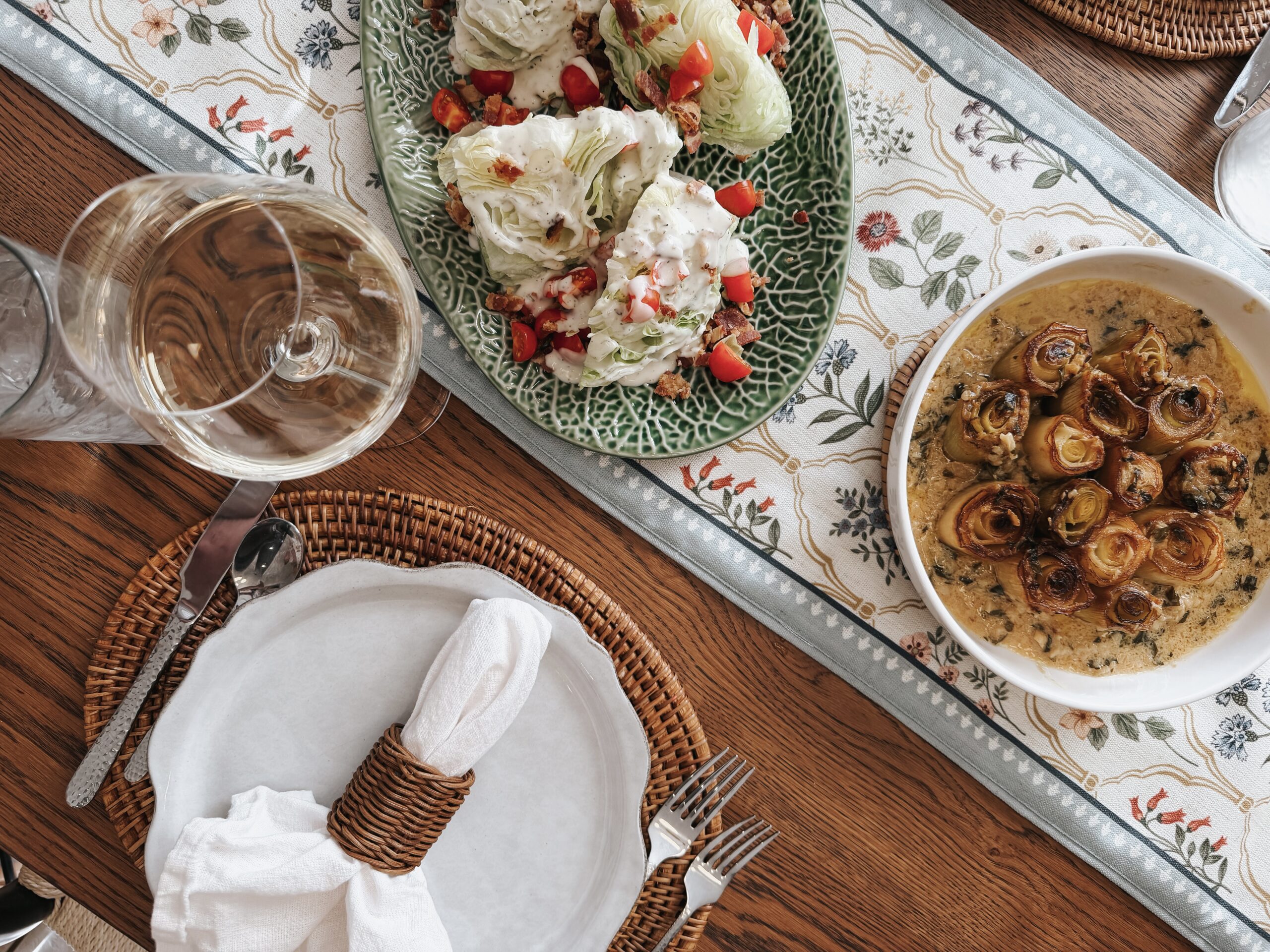
The rest of us — six at the table instead of seven — sat down to a proper Easter dinner in Winter Park. Tenderloin. Braised leeks in white wine sauce. Potatoes gratin. Wedge salads with homemade blue cheese dressing. Homemade tomato focaccia still warm from the oven. And the carrot cake, because that is simply how Easter ends in this house.
Someone asked if we were going to scale back since we weren’t hosting anyone. We were not.
This is something we feel strongly about: the occasion does not require an audience to be worth honoring. Feast days are feast days whether there are twenty people at the table or six. The table gets set properly. The kids dress for dinner. Not because anyone is watching, but because we are — because we are the audience for our own lives, and we want those lives to look and feel like something.
We have five children ranging from baby to teenager. We want them to grow up knowing what a well-cooked meal tastes like and what a properly set table looks like. We want them to know how to sit at one — how to be present at a meal, how to behave at a dinner that took someone hours to prepare. We believe you learn those things by doing them, repeatedly, from the time you are small. So we do them.
Our six-year-old helped set the table this year. She knows where the forks go and how to fold a napkin, and she takes both seriously. The toddler boys are beginning to help too, in the way toddlers help — enthusiastically and with mixed results. Even that is part of it. You start somewhere.
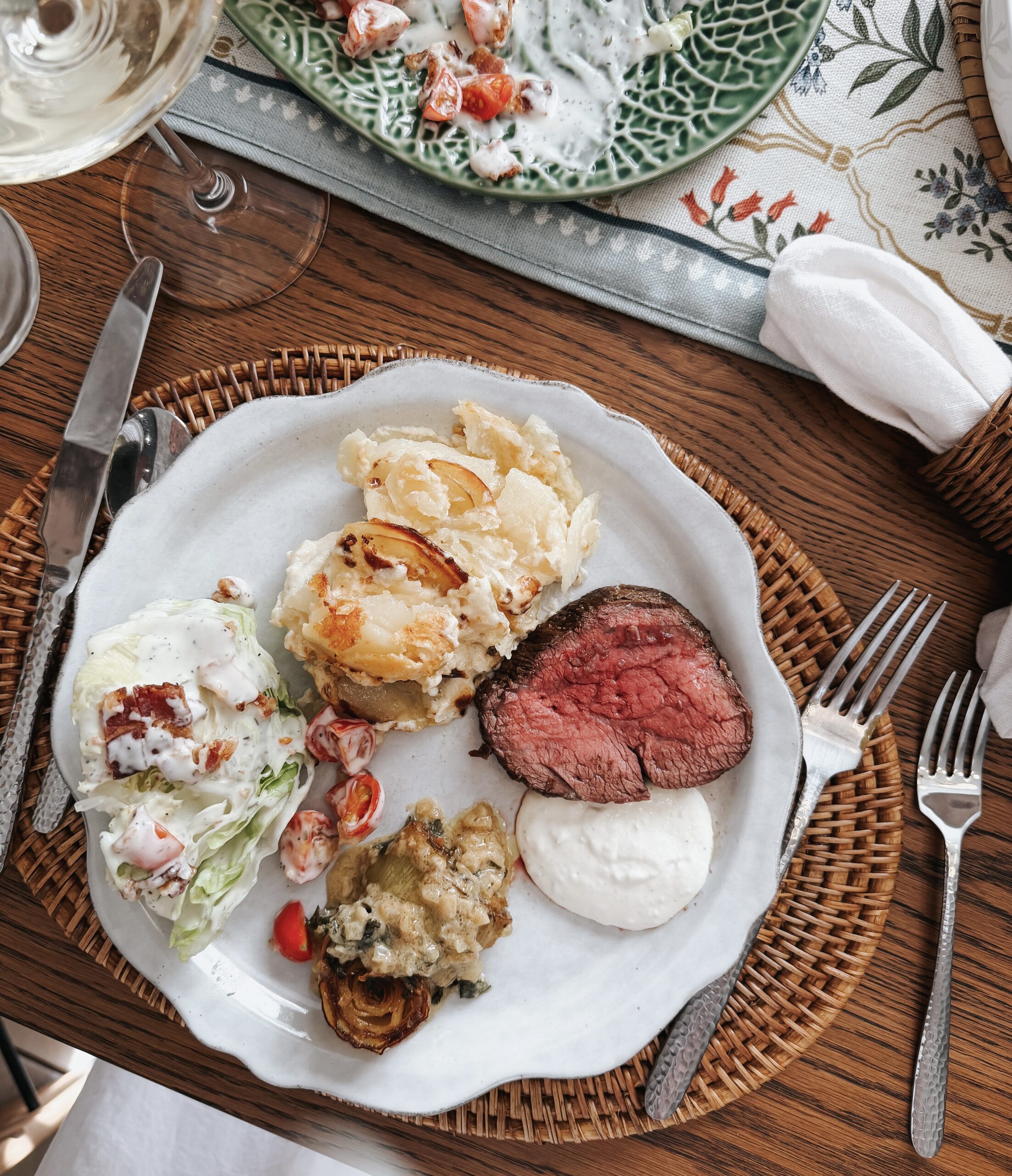
The menu is something we’ve been working on for years. Not every holiday has a locked-in menu yet — that’s still in progress — but Easter is close. This year felt nearly right. There will be small refinements. There always are. But the bones are there, and that’s its own kind of satisfaction.
We typically do lamb for Easter, but this year with a smaller table we made a different call — beef tenderloin, which we usually reserve for Christmas. With six instead of seven and no guests to feed, it felt like the right moment for a more indulgent cut. It was the right call.
What we served:
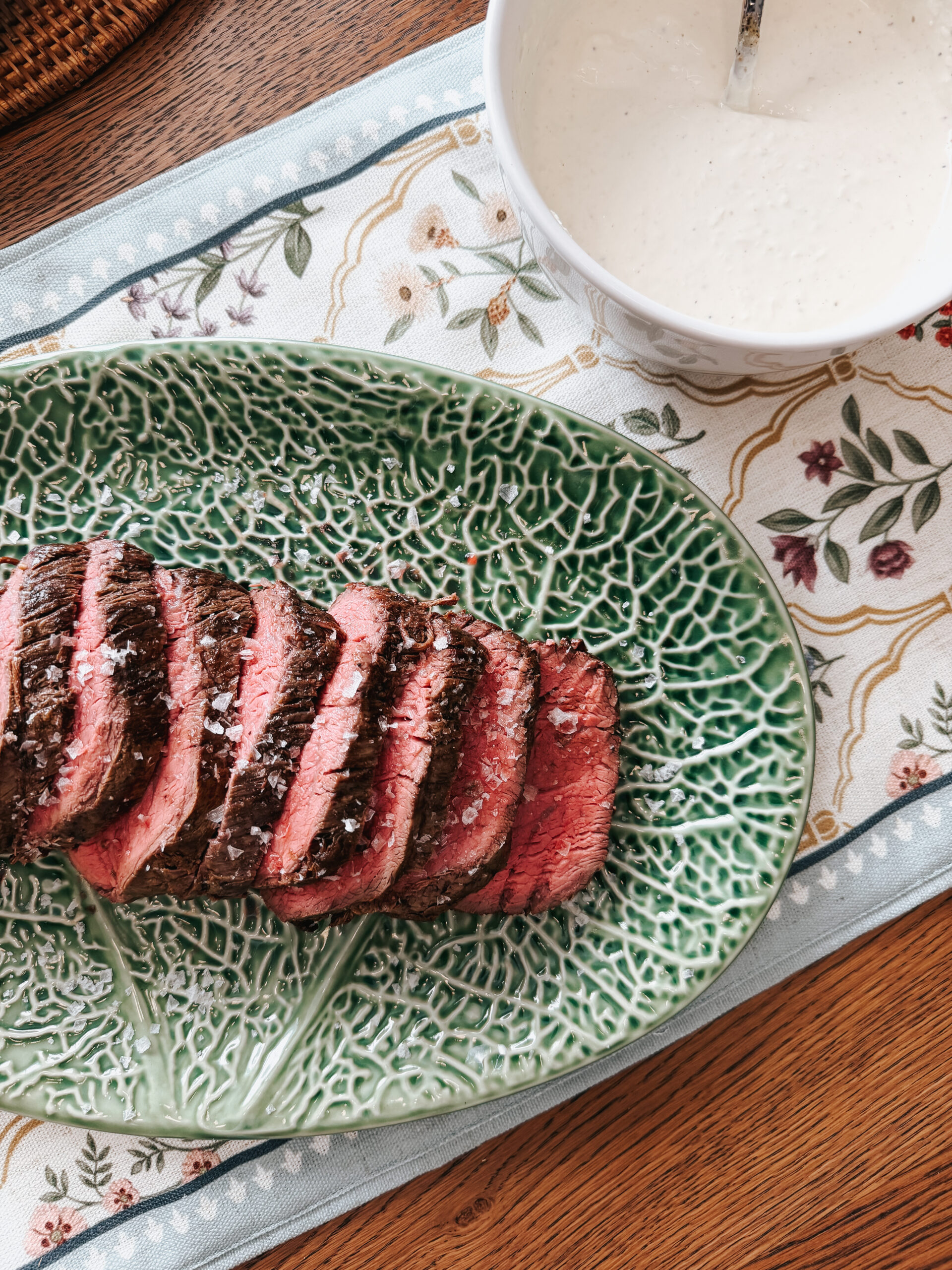
Beef tenderloin with homemade horseradish cream. Cooked to perfect medium rare throughout, finished with flaky salt, and served alongside a simple homemade horseradish cream that cuts through the richness cleanly. The kind of main course that makes the table go quiet for a moment.
Braised leeks in white wine sauce. The dish that surprised everyone most and generated the most conversation. Leeks slow-braised until silky and caramelized, finished in a white wine sauce with herbs. The full recipe deserves its own post and will get one.
Potatoes gratin. Layered, cream-soaked, with the kind of crispy top layer that disappears first. Non-negotiable.
Wedge salad with homemade blue cheese dressing. Classic, cold, a good counterpoint to everything else on the table. Served on the Bordallo Pinheiro cabbage leaf platter — one of the hardest working pieces of serveware we own.
Homemade tomato focaccia. Dimpled, olive oil-soaked, gone before dinner was fully on the table. It didn’t make it into the photographs because it didn’t make it long enough.
Carrot cake. Always. See below.
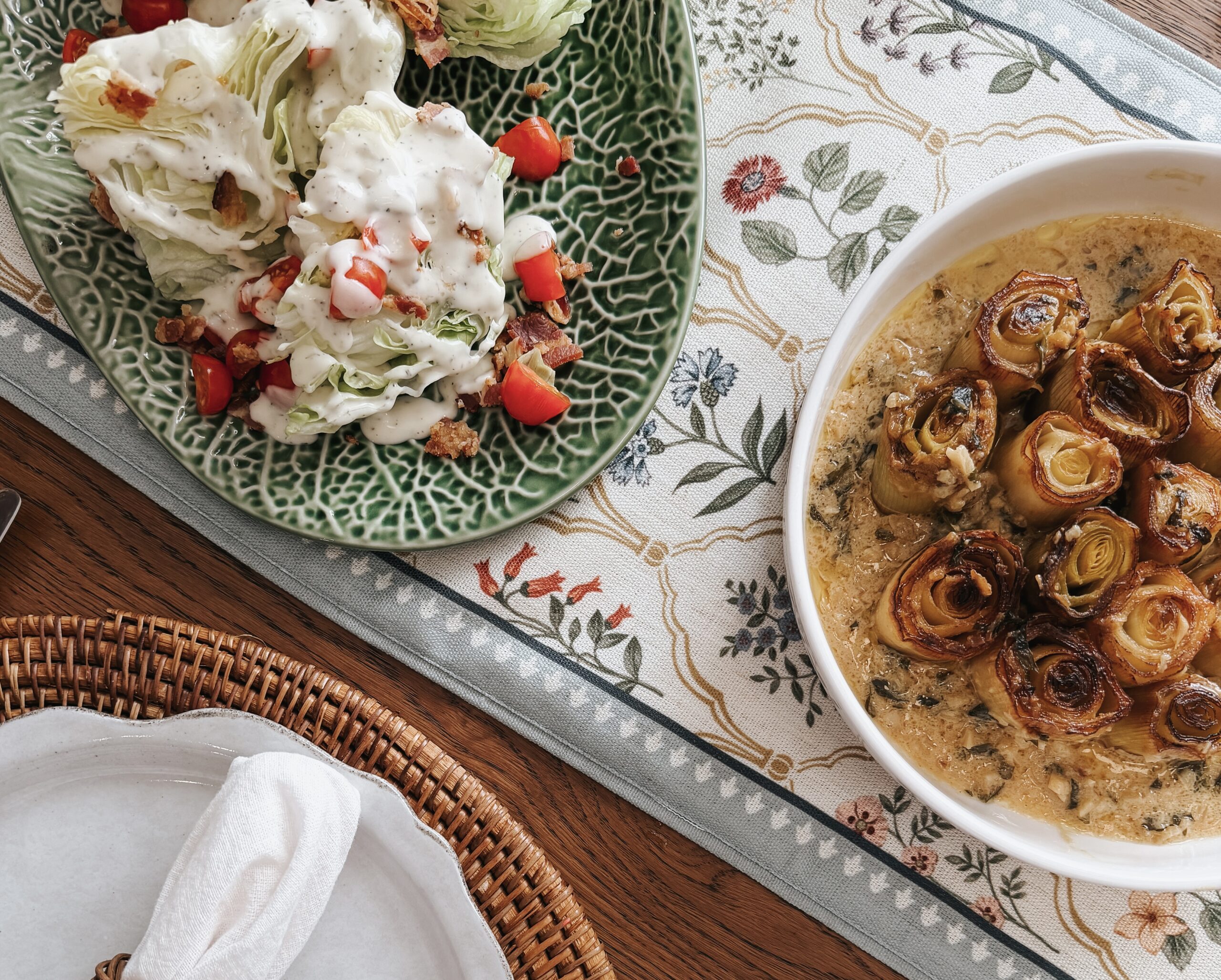
A note on the table: we use holidays as an excuse to bring out the things that deserve to be used. The floral linen runner. The rattan chargers. Linen napkins in wicker rings. The Bordallo Pinheiro platters in forest green. The table should look like someone cared. It takes twenty minutes to set it properly and it changes the entire feeling of the meal — not just for the adults, but for the children sitting at it. They notice. They always notice.
The Carrot Cake
This is the one. The dessert that has been on our Easter table long enough that the kids would notice its absence the way they’d notice a missing chair. I make it once a year, at Easter, and only at Easter — which is part of why it tastes the way it does. Anticipation is an ingredient.
The base is adapted from a recipe I found years ago on Epicurious and have been refining ever since. My changes are not small. I use a good olive oil in place of vegetable oil — something I learned from cooking more with Mediterranean pantry staples — and it produces a more nuanced, tender crumb. I also bake almost exclusively with Italian 00 flour now, and the difference in texture is noticeable. Finer, softer, more delicate than all-purpose produces.
The nuts stay out of the batter entirely. Instead I press salted crushed pecans into the exterior of the frosted cake — which gives you the crunch and the salt in every bite without disrupting the interior texture. The cream cheese frosting is generously applied and lightly sweet. It is not a shy cake.
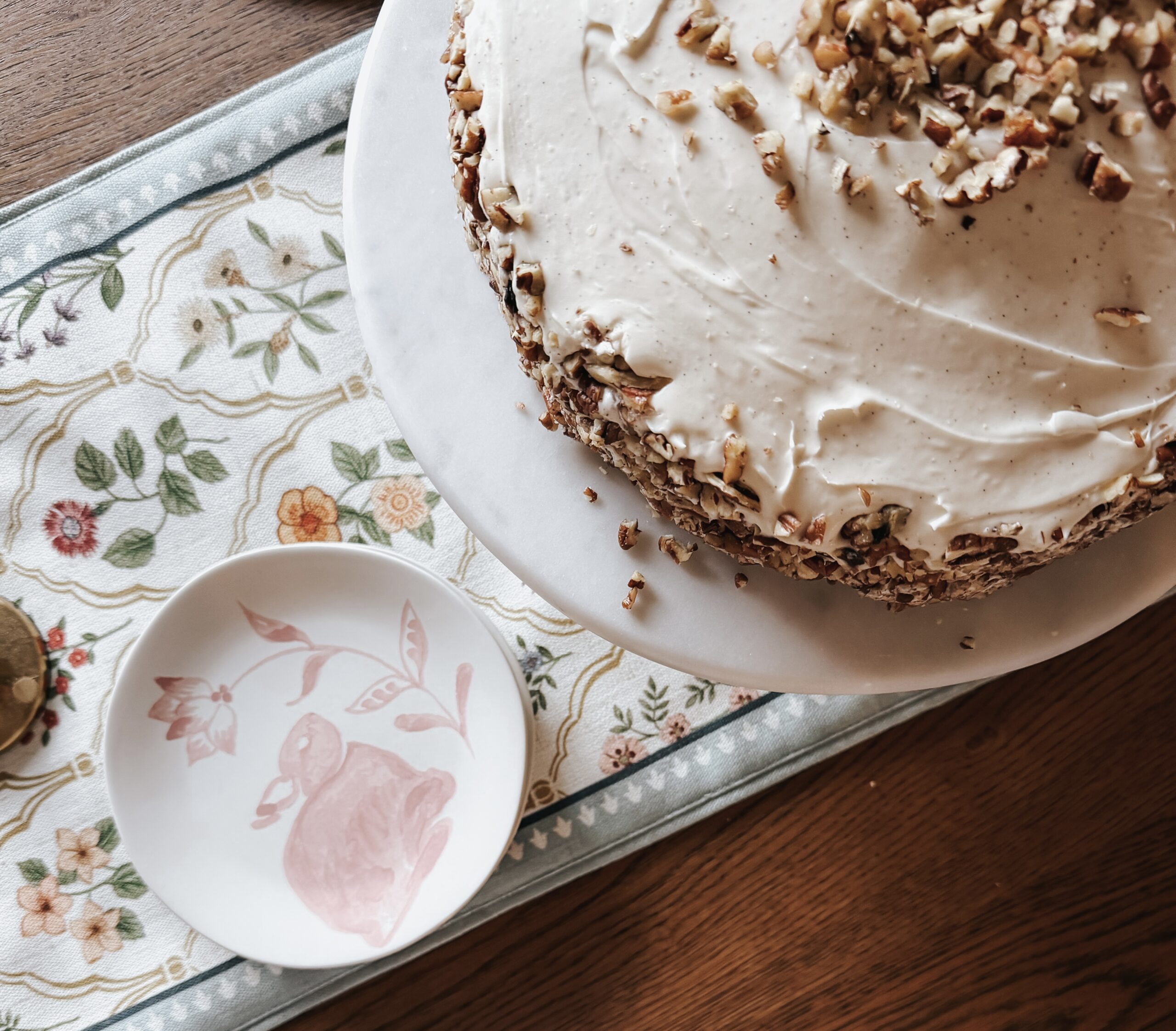
Our Easter Carrot Cake Adapted from Epicurious Serves 10–12
For the cake: 2 cups (240g) Italian 00 flour 1 tsp baking powder ¾ tsp baking soda ¾ tsp fine sea salt 2 tsp ground cinnamon ½ tsp freshly grated nutmeg ¼ tsp ground allspice 2 cups (426g) light brown sugar 4 large eggs, room temperature 1 cup (198g) good olive oil 1 lb carrots, trimmed, peeled, and finely grated (about 3 lightly packed cups) 1 Tbsp unsalted butter, for greasing pans
For the cream cheese frosting: Two 8 oz packages (453g) cream cheese, chilled 11 Tbsp (155g) unsalted butter, softened 1⅓ cup (151g) powdered sugar, sifted after measuring 1 Tbsp pure high quality vanilla bean paste or gel
For finishing: ½ cup pecans, lightly toasted, crushed, and salted
Make the cake:
Preheat your oven to 375°F with a rack in the middle position. Butter two 9-inch round cake pans and line the bottoms with parchment.
Whisk together the flour, baking powder, baking soda, salt, cinnamon, nutmeg, and allspice in a large bowl and set aside.
In the bowl of a stand mixer fitted with the paddle attachment, mix the brown sugar on low speed to break up any lumps. Add one egg and mix on low until smooth, then add the remaining eggs one at a time, mixing until fully incorporated after each. Scrape down the bowl and paddle. With the mixer on low, stream in the olive oil slowly and beat until fully combined.
Add the dry ingredients in three batches, folding gently with a large rubber spatula until just incorporated after each addition — do not overmix. Fold in the finely grated carrots.
Divide the batter evenly between the prepared pans and smooth the tops. Bake for 25 to 30 minutes, checking at 25 — the layers are done when risen and firm and a paring knife inserted in the center comes out clean. In our experience 40 minutes is too long; start checking early. Cool in the pans for 5 minutes, then turn out onto wire racks and cool completely before frosting.
Make the frosting:
Beat the chilled cream cheese and softened butter together on medium speed until smooth, about 30 to 60 seconds. Scrape down the bowl. Add the sifted powdered sugar and vanilla and beat on medium until light and fluffy, about 2 minutes.
Assemble:
Place one cake layer on your serving plate and spread roughly a third of the frosting across the top. Place the second layer on top, flat side up. Spread the remaining frosting over the top and sides of the cake. Press the salted crushed pecans firmly into the sides of the cake, working around the exterior until fully coated. Finish with a scattering of pecans across the top.
Keep at cool room temperature until serving. The cake can be made a day ahead and kept under a cake dome.
The braised leeks recipe is coming soon — it was the quiet star of this particular table and deserves its own space.





Read the Comments +